AI app development cost
How Much Does It Cost to Build an AI App in 2026? A Complete Guide
Quick Summary * Building an AI app can cost anywhere from $15,000 to over $500


In the new era of digital business, companies are under continuous stress to introduce mobile applications within a short time interval without sacrificing either quality or performance. It is here that the react native app development has gained popularity. It enables companies to develop both iOS and Android apps with one codebase, which saves them time and cost.
Nevertheless, selecting the appropriate approach is not only a matter of technology, but it is also a matter of being familiar with how the framework functions, when it is applicable, and how to utilize it to the best of its potential through a trusted react native app development company.
This guide explores further React Native, its advantages, process, costs, and best practices in order to make informed decisions.
React Native is an open-source platform, which allows developers to develop mobile apps with JavaScript and React. React Native does not use web views unlike traditional hybrid frameworks. Rather, it makes use of the native elements, and this implies that the end product resembles and functions as a native app.
This is a way of closing the performance-efficiency gap. Businesses are able to gain a near native experience and at the same time enjoy increased development cycles. This balance is one of the largest factors that led to the increase in react native app development services as far as companies are concerned in seeking such services.
Also Read: Flutter vs React Native: Which Framework is Better for App Development?
React Native is actively spreading its roots due to the fact that it perfectly suits the requirements of the contemporary business world, i.e. it is fast, scalable, and cost-efficient.
The insights of industry would indicate that more than 35-40% of developers actively utilize the React Native in cross-platform projects. It is also claimed that the savings of up to 40-60% in costs are reported by businesses in comparison to native development, which is mainly because of shared codebases and fewer team requirements.
The next contributing factor to its popularity is that it allows the re-use of web development skills. The fact that most developers are familiar with JavaScript also means that companies can hire talent or partner with a react development agency without extensive onboarding cycles.
The capability to share a single piece of code between various platforms is one of the greatest benefits of React Native. This helps mitigate redundancy of work and maintain the same level of functionality which is easily maintained and updated as time goes by.
React Native has native components, and that is why users have a smooth and responsive experience. Although it might not be as good as fully native apps in all situations, it is really outstanding in the majority of business applications.
Hot reloading enables developers to view changes in real-time without relocating the app. This accelerates the development process and facilitates testing features and UI enhancements.
React native has a vast developer base and vast libraries, and it provides solutions to most development challenges. This cuts the development time and enhances flexibility.
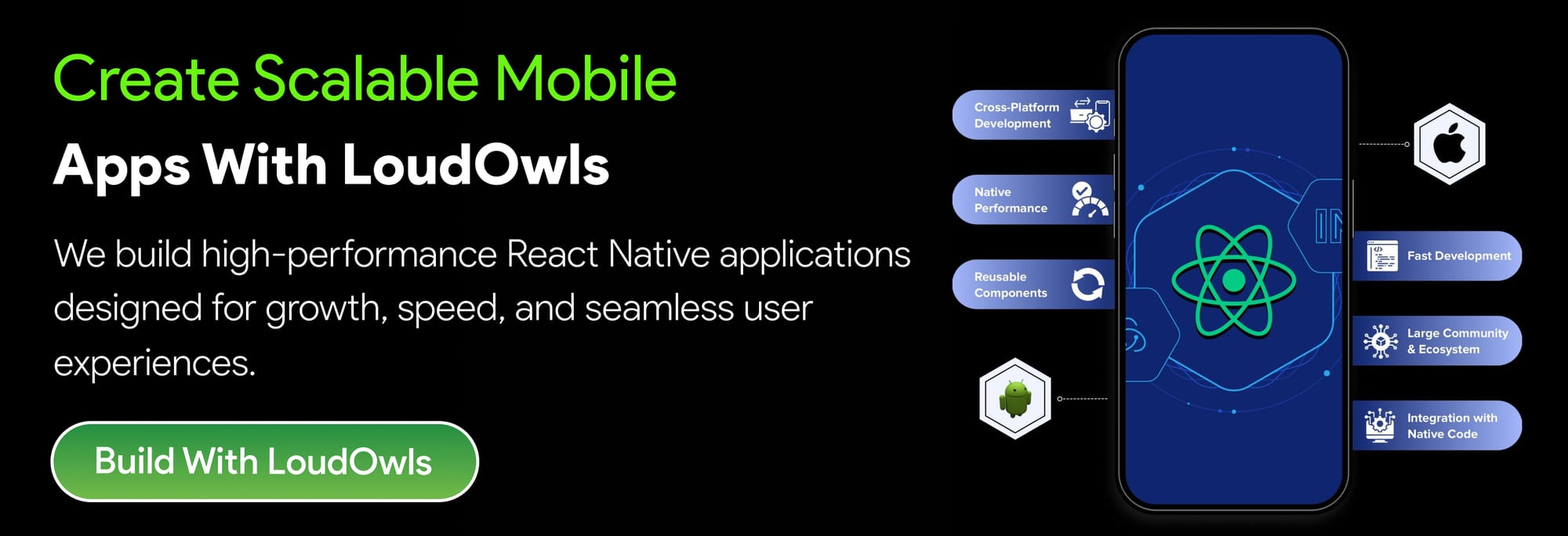
An expert react native application agency is systematic in outlining the quality and efficiency in the project life cycle.
Development Stages
All the phases are vital in making sure the end product is scalable, secure, and aligned to the business goals.
Also Read: How Much Does Mobile App Development Cost in 2026? Complete Pricing Guide
The cost is a factor that must be understood before the initiation of any project. The total investment in react native app development is determined by several variables such as complexity of the app, features and experience of the developers.
Estimated Cost Breakdown
These are only approximate estimates, but having a good react native app development company can assist in ensuring that the cost and development time are optimized through the selection of the appropriate architecture and tools.
React Native also saves a lot of time during development, as a developer can write a single code that can be used on all platforms. This can be used to especially advantage startups that must launch fast and prove their concepts.
As one team will be capable of developing Android and iOS, businesses will save money on employment and operational expenses. This is why React Native is a cost-efficient option for numerous organizations.
Components that can be reused simplify the development process and minimize the probability of errors. It is also simpler and more efficient to update it in the future.
React Native applications can be scaled with the growth of your business. They will be able to handle growing users and capabilities without significant performance problems with an appropriate architecture.
React Native is not a universal tool, but it is remarkably effective in numerous situations.
It is especially appropriate in cases of start-ups and companies interested in introducing MVPs within a short period without investing extensively. It is also perfect in those applications that are targeted to both Android and iOS users at the same time.
Nonetheless, in the case of very complicated applications with heavy graphics, playing games, or advanced hardware integrations, native development can be a superior choice.
Although React Native has numerous benefits, one should remember about the limitations.
It can also have a slightly lower performance than fully native apps, particularly when dealing with very complicated functionality. Also, certain functionalities might need third-party libraries or native modules that can be written in-house, making development more complex.
JavaScript and native components interaction may also make debugging more complicated. That is why it is important to cooperate with the agency of experienced react development to prevent possible problems.
Choosing the appropriate partner may or may not determine your project. A sound react native app development company does not just offer technical skills but also offers strategic advice.
Seek a firm with a solid portfolio, successful experience, and well-established development cycle. Communication is also of essence, frequent updates and transparency will help keep the project on track.
Another important factor is after sales services. You will require updates, bug fixes, and performance improvement as time progresses and, therefore, you should select a partner that will provide a long-term support.
In order to achieve the best outcome of your project, you should adhere to the best practices.
Write efficient code and ensure that you reduce the number of unnecessary re-renders. Use native modules where there are complex features that need high performance.
Focus on the user experience through making designs responsive and intuitive. Testing must be conducted intensively on the devices to check compatibility and reliability.
Lastly, keep clean and scalable code so that it can be expanded and updated as needed.
React Native is still being developed to improve performance and architecture. It has been more reliable and effective than ever before due to the introduction of new features and enhancements.
It is observed that in 2026, there is more adoption of React Native in enterprise applications, and the ability to integrate and perform better with developed architectures.
React Native is likely to continue to be an important part of cross-platform apps development as the ecosystem matures.
React native app development is a very potent mix of speed, flexibility, and cost-effectiveness. It allows companies to create quality apps without necessarily having to have a different development team per platform.
With a correct selection of react native app development services and cooperation with a reliable react native app development company, companies can develop scalable and easy-to-use applications that satisfy the requirements of the contemporary markets.
In the end, however, it is not only a matter of the framework, but its implementation.
1. Does React Native make sense in the startup app development?
Yes, React Native is a great option to start ups due to its quicker development, lower cost and the ability to enter the market within a short time with a single codebase.
2. Is React Native capable of supporting large-scale applications?
React Native is capable of supporting large-scale applications with appropriate architecture. Nonetheless, even very sophisticated features can be better served by native modules.
3. Do React Native apps need iOS and Android teams?
No, one of the greatest benefits is that a team can create on one platform and use it on the other, although certain platform-specific changes might be required.
4. React Native app security.
When best practices are observed, such as encryption of data, secure APIs, and proper authentication, react native applications can be very secure.
5. What are the things to consider before selecting React Native?
Before making the decision on whether React Native is suitable or not, consider your app complexity, performance needs, budget, timeline and long-term scalability.

Quick Summary * Building an AI app can cost anywhere from $15,000 to over $500
LoudOwls

Quick Summary * This blog explores the latest mobile app development trends re
LoudOwls

Key Takeaways ● A food delivery app like DoorDash typically costs $150,000
LoudOwls