AI app development cost
How Much Does It Cost to Build an AI App in 2026? A Complete Guide
Quick Summary * Building an AI app can cost anywhere from $15,000 to over $500
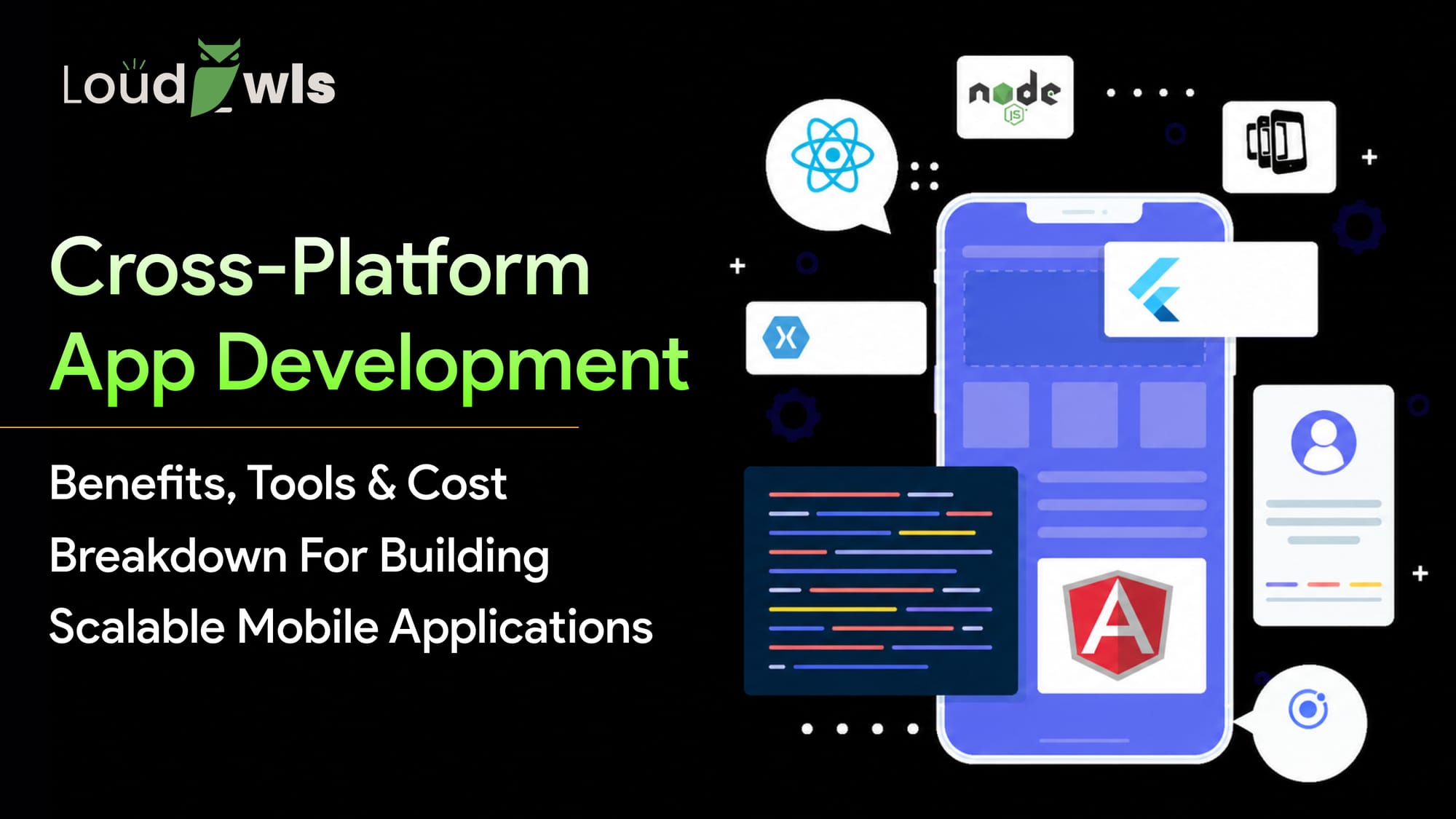

In the modern era of digitalization, companies always seek to find a solution that will help them create applications in a shorter amount of time, at a lower price, and access more users. It is in this context that the cross platform app development has turned out to be a game changer.
The companies do not have to create individual apps (iOS and Android) anymore and can create one application that is compatible with various platforms. This saves time, resources and also provides a uniform experience to users.
However, what are cross platform apps, and how do they differ with native development? We will discuss all that you need to know, benefits, tools and costs.
Cross platform application development is the development process of creating mobile applications that work across more than one operating system using one codebase.
Cross platform apps also enable developers to use the same code, unlike native apps that require them to be developed separately in Android and iOS.
This technique is closely linked to hybrid application development, but new frameworks such as Flutter and React Native can achieve near-native performance, and thus are more sophisticated than other hybrid systems.
Cross-platform apps have gained a lot of demand in recent years.
As per the industry reports:
These advantages render cross platform app development the favorable option among both startups and enterprises.
Among the most significant is the speed. The developers can use the same codebase and this makes the development process to be a lot faster.
This enables companies to introduce products fast and be ahead of competition.
One of the reasons why companies opt to use cross platform solutions is cost saving.
Businesses can use one team instead of employing different teams to develop iOS and Android applications, thereby saving a lot of money.
A single application that is used in many platforms allows business to access more people without extra efforts.
It is easier to maintain a single codebase instead of maintaining several versions of an app. Bug fixes and updates can be implemented everywhere.
Contemporary systems guarantee the customers a similar experience on different devices, a factor that is critical in brand identification.
Hybrid app development and cross platform development are not exactly synonymous with each other, though they are used interchangeably.
Cross platform frameworks have become very popular in modern times because they were more efficient and flexible than the traditional hybrid methods.
It is important to select the appropriate tools in order to create quality apps.
One of the most rapid methods in 2026 is the Flutter app development. It offers:
Flutter is the best in apps whose design needs to be rich and has smooth movements.
React Native development is a flexible and large ecosystem that is still a popular choice.
Benefits include:
It has a large application in the sphere of business and enterprise.
Cost effectiveness is one of the greatest benefits of cross platform apps.
Breakdown of Costs (Estimated).
When applying cross platform app development, the business will save up to 40 per cent of the native development.
The total cost is affected by several factors:
These factors are useful in budget planning by businesses.
In spite of the advantages, cross platform development is accompanied by a set of challenges.
Even though the modern frameworks provide the near-native performance, there are still highly complex apps that might need the native development.
Some features of the device may be limited or need more customization.
Businesses must adhere to the following best practices to guarantee success:
The practices are beneficial in order to optimize the advantages of cross platform app development.
The future of cross platform apps has a bright future.
The following trends are expected in 2026:
With the advancement in technology, cross platform development will remain the leading mobile app industry.
The development of cross platform apps has revolutionized the way business is carried out in regard to mobile apps development. It provides a strong alternative to the traditional native development because it allows quicker development, cost reduction, and broader access.
Regardless of your preference towards flutter app development due to its design flexibility or react native development due to its advantages in an ecosystem, it is important to choose the right approach depending on the objective of your business.
Cross platform apps can be used to achieve high performance, scalability and success in the long term with the correct strategy and development team.
1. What is cross platform application development?
Cross platform application development refers to the development of mobile application that can run on different operating systems based on the same codebase.
2. Which is superior between cross platform development and native development?
It is contingent on the project. Cross platform is less expensive and quicker whereas the native development has better performance on highly complex apps.
3. What is the cost of cross platform app development?
The price can be between 20,000 and 300,000 and above depending on the complexity of the app and its features.
4. Flutter or React Native: Which is more superior?
Flutter is superior in custom UI and performance whereas the React Native is superior in quick development and robust third-party integrations.
5. Are cross platform apps appropriate with startups?
Yes, the cross platform apps are perfect in startup since it saves money, faster development and easy market penetration.

Quick Summary * Building an AI app can cost anywhere from $15,000 to over $500
LoudOwls

Quick Summary * This blog explores the latest mobile app development trends re
LoudOwls
Key Takeaways ● A food delivery app like DoorDash typically costs $150,000
LoudOwls