

Why Canada Is One of the Best Markets to Launch a Food Delivery App Right Now
Canada's food delivery sector has grown dramatically over the past five years, driven by a shift in how urban and suburban Canadians choose to eat. Convenience is no longer a premium preference — it's an expectation built into daily routines.
What makes this moment particularly interesting for new entrants is not the size of the market, but its structure. Platforms like DoorDash and Uber Eats have claimed the major cities, but they've done so with a model that frustrates two of the three parties involved: restaurants paying commission rates as high as 30%, and drivers navigating rigid scheduling with inconsistent earnings.
That friction is a real opening. Startups that build leaner, more equitable platforms — particularly those targeting underserved mid-size cities or specific cuisine categories — are finding traction that would have been difficult five years ago.
This guide is for founders, product managers, and business owners who want a clear, honest picture of what it takes to build a food delivery app in Canada: the real costs, the technology decisions that matter, the competitive dynamics, and the strategies that move the needle.
The Canadian Food Delivery Market: Where the Real Opportunity Sits
The dominant platforms have concentrated their resources on Toronto, Vancouver, and Montreal. This is where the density works in their favour — more restaurants per square kilometre, more drivers available, shorter routes. But it also means the rest of Canada is largely underserved.
Cities like Calgary, Edmonton, Ottawa, Halifax, Winnipeg, and Quebec City represent a combined population of millions with growing digital adoption and limited delivery choices. Residents in these markets often experience longer wait times, smaller restaurant selections, and less competitive pricing than their counterparts in major metros.
Beyond geography, several category-level gaps are equally compelling:
• Health-focused and dietary-specific delivery — vegan, halal, gluten-free — remains fragmented
• Local restaurant discovery is poor on generic platforms, which prioritise chain partners
• Scheduled and catered delivery for offices and events is almost entirely untapped
• Alcohol and grocery delivery integrations create bundling opportunities that DoorDash and Uber Eats have only partially explored
How DoorDash and Uber Eats Actually Make Money — and Where They're Vulnerable
Understanding the revenue model of the market leaders is essential before designing your own. Both platforms generate income from four primary sources.
- Restaurant commissions
This is the largest revenue line. Restaurants pay a percentage — typically between 15% and 30% — on every order placed through the platform. For independent restaurants already operating on tight margins, this is a significant and growing source of tension. Many operators have publicly stated that the commission rates make delivery economically unviable without raising menu prices.
- Delivery fees and dynamic pricing
Customers pay a delivery fee that fluctuates based on demand, distance, weather, and driver availability. Surge pricing during peak hours can make an order considerably more expensive than the same meal ordered directly. This frustrates users and creates an opening for platforms that price more predictably.
- Subscription programmes
Both DoorDash (DashPass) and Uber Eats (Uber One) offer monthly subscriptions that waive delivery fees and offer promotional discounts. Subscriptions are a retention mechanism that locks users into a single platform — one of the harder competitive advantages to overcome directly.
- In-app advertising
Restaurants can pay to appear prominently in search results and category listings. This creates a pay-to-play dynamic that disadvantages smaller operators who cannot afford promotional spend. A platform that surfaces genuinely relevant restaurants — rather than the highest bidder — would earn strong loyalty from both restaurants and consumers.

What Your Food Delivery App Needs to Compete in 2025
Feature parity with existing platforms is the baseline. What wins users and retains restaurants are the details of execution — speed, reliability, and the moments where your platform visibly treats people better than the alternative.
Customer-facing app
✓ Account creation with saved preferences, dietary filters, and address book
✓ Real-time order tracking with driver location and estimated arrival
✓ Multiple payment options: credit, debit, digital wallets, and pay-later
✓ AI-driven recommendations based on order history, time of day, and weather
✓ Reorder with one tap and the ability to schedule future deliveries
✓ Transparent fee breakdown before checkout — no hidden costs at payment
Restaurant dashboard
✓ Live order management with status updates pushed to kitchen displays
✓ Menu builder with item-level customisation, photos, and availability toggles
✓ Daily, weekly, and monthly analytics broken down by item, time, and order source
✓ Direct messaging with customers for order clarifications
✓ Commission and payout transparency — no surprises
Driver app
✓ Intelligent route optimisation that accounts for traffic and delivery sequence
✓ Flexible availability scheduling with advance notice earnings estimates
✓ Earnings dashboard with weekly breakdown and instant payout options
✓ In-app support and issue reporting for real-time problem resolution
How AI Changes the Economics of Food Delivery
Artificial intelligence is not a differentiating feature for the next generation of food delivery platforms — it is the operating infrastructure. The platforms that will win are the ones that use AI to reduce cost per delivery, reduce friction per order, and increase relevance per recommendation.
- Personalisation that converts
When a user opens your app, they should not see a generic list of restaurants. An AI-driven interface surfaces the right options at the right moment — based on their previous orders, the time of day, local weather, promotional availability, and even past complaints. This level of personalisation increases order frequency and average basket size measurably.
- Demand forecasting
The costliest inefficiency in food delivery is mismatched supply and demand — too few drivers on a Friday night, too many on a Tuesday afternoon. Predictive models trained on historical data, local events, and seasonal patterns allow platforms to pre-position drivers before demand spikes rather than reacting after it arrives. This directly reduces delivery times and driver wait costs.
- Dynamic and fair pricing
AI-driven pricing does not have to mean punishing surge pricing. It can mean intelligent, transparent adjustments that ensure driver earnings remain competitive during high-demand windows while keeping the cost to customers within an acceptable range. Platforms that communicate pricing logic clearly build more trust than those that obscure it.
- Fraud prevention
Delivery platforms are frequent targets for fraudulent orders, account takeovers, and refund abuse. Machine learning systems that identify anomalous patterns in real time — without requiring human review — reduce financial exposure significantly and protect both customers and restaurant partners.
What Does It Actually Cost to Build a Food Delivery App in Canada?
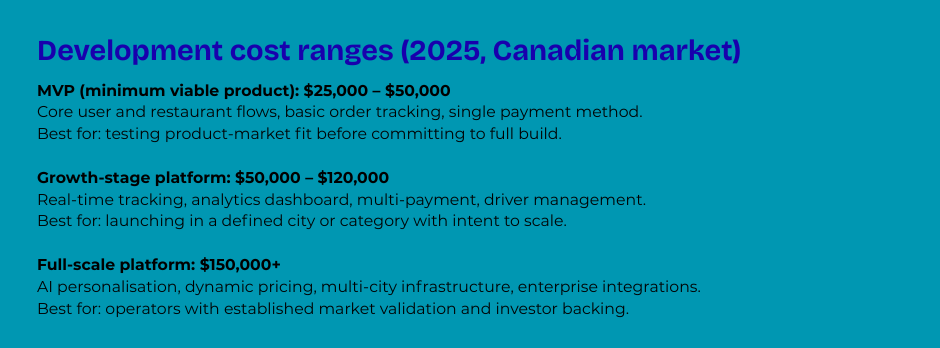
Development cost estimates vary widely because the question is rarely precise. The right answer depends on whether you need a market-testing MVP or a production-ready platform with enterprise integrations. Here is an honest breakdown.
Ongoing costs to plan for
Development is a one-time investment. Operating a delivery platform is not. Budget for the following recurring expenses from day one:
• Cloud infrastructure: $500 – $5,000/month depending on order volume
• Payment processing: 2.5% – 3% per transaction
• Customer support staffing or tooling
• Marketing and user acquisition (typically the largest variable cost in year one)
• App store fees (15% – 30% on subscription revenue)
• Ongoing development for features, security patches, and platform updates
Technology Stack Decisions That Will Affect You for Years
The technology choices you make at the start of a project are rarely neutral. They shape your hiring pool, your future scaling costs, and your ability to move quickly when the market demands it.
- Frontend
React Native and Flutter are both strong choices for cross-platform development. React Native has a larger talent pool in Canada, which matters when you need to hire. Flutter offers tighter performance consistency across Android and iOS, which matters when you are competing on user experience.
- Backend
Node.js is the industry default for real-time delivery applications because of its event-driven architecture and strong ecosystem. Python is increasingly competitive, particularly if you intend to build significant AI or data pipeline components. Both are defensible choices; the decision should follow your team's existing expertise.
- Database
PostgreSQL handles relational data — orders, users, financial records — with the reliability and query complexity that a delivery business requires. MongoDB is a reasonable choice for unstructured data like session logs and user behaviour events. Most mature platforms end up using both.
- Cloud infrastructure
AWS, Google Cloud, and Microsoft Azure all support the scale required for a food delivery platform. AWS has the widest service selection and most Canadian engineering talent familiar with it. Google Cloud has pricing advantages and strong managed services for AI workloads. Azure is worth considering if you anticipate enterprise partnerships or government clients.
Logistics: The Operational Challenge Nobody Warns You About
Technology is the enabler. Logistics is the product. A customer does not care what database you use — they care whether their food arrives in 30 minutes at the temperature it left the restaurant.
Last-mile delivery — the final leg from restaurant to customer — is where most delivery platforms struggle, and most cost overruns occur. The variables are numerous: traffic, driver availability, restaurant preparation times, building access, and weather. The platforms that handle this well are the ones that treat logistics as a system to be designed, not a problem to be managed reactively.
- Route optimisation
AI-driven routing systems that account for real-time traffic, multi-stop sequences, and restaurant prep times reduce average delivery time significantly. A 10% reduction in average delivery time has a measurable impact on customer satisfaction scores and reorder rates.
- Batch delivery
Grouping multiple orders from nearby restaurants into a single driver run improves efficiency during peak hours. Done well, it reduces cost per delivery and increases driver earnings per hour. Done poorly, it results in cold food and frustrated customers. The difference is in the algorithm and the incentive structure.
- Driver supply management
Ensuring the right number of drivers are available in the right areas at the right times is a forecasting and incentive problem. Platforms that solve this with predictive scheduling and location-based availability bonuses outperform those that rely on reactive surge pricing alone.
Building a Revenue Model That Works for Everyone
The most common mistake new delivery platforms make is copying the commission model of the market leaders at the same rates. This guarantees you will be competing on their terms, with their margins, against their brand recognition.
A differentiated revenue model is not just a business strategy — it is a marketing message. Restaurants that have been paying 25% to DoorDash will notice when you offer 12%.
- Commission with a ceiling
Charging a lower commission rate — with a fixed maximum per order rather than an open-ended percentage — makes your cost structure predictable for restaurant partners. Predictability is valuable to operators managing tight margins.
- Subscription tiers for restaurants
A monthly subscription that includes a lower per-order commission, analytics access, and marketing features converts the restaurant relationship from transactional to partner-like. It also creates recurring revenue that is less volatile than per-order commission alone.
- Customer subscriptions
Free delivery subscriptions are table stakes. Consider structuring yours with genuine value-adds — priority driver assignment during peak hours, access to exclusive restaurant offers, and carbon-offset delivery options — rather than just waiving delivery fees.
- Advertising with integrity
Sponsored placement is legitimate revenue. The distinction that builds long-term trust is ensuring that paid placement is clearly labelled and that organic search results still return genuinely relevant results. Users who trust that non-sponsored recommendations are honest become loyal users.
How to Build a Platform Restaurants and Customers Actually Prefer
- Go deep before going wide
The temptation is to launch in multiple cities at once to demonstrate scale. The smarter path is to dominate one city or one category first. Build the reputation, the restaurant relationships, and the operational efficiency locally before expanding. The platforms that try to be everywhere rarely excel anywhere.
- Make the restaurant relationship central
Every feature decision should include the question: does this help our restaurant partners earn more or operate more efficiently? Platforms that genuinely improve the economics of their restaurant partners create advocates, not just vendors. Those advocates refer other restaurants, resist churning to competitors, and participate in your marketing without being asked.
- Build for transparency
Show customers the full breakdown of every fee before they confirm an order. Show drivers their expected earnings before they accept a route. Show restaurants their true net revenue after commission. Transparency is not a legal obligation — it is a positioning decision that separates you from platforms that bury costs in fine print.
Invest in customer support before you need it
The moment a delivery goes wrong is the moment a customer decides whether they will ever use your platform again. A responsive, empowered support function that resolves issues quickly and fairly turns a negative experience into a retention event. This is operationally expensive but strategically essential.

Challenges to Prepare for Before You Launch
Entering the food delivery market in Canada is a serious operational undertaking. The following challenges are predictable — and therefore manageable if you plan for them.
- Regulatory compliance
Food delivery platforms operating in Canada must navigate labour regulations governing gig workers, food safety standards, data privacy requirements under PIPEDA, and provincial variations in employment classification. Legal counsel with specific technology sector experience is not optional at launch.
- Customer acquisition cost
Acquiring the first wave of users in a new market typically requires promotional offers, referral programmes, and paid marketing that erode early-stage unit economics. Model this conservatively. Budget for a longer path to contribution margin-positive orders than you expect.
- Competitive response
If you gain meaningful traction in a specific city or category, expect the incumbents to respond — either with targeted promotions in your market or with copycat features. Build your competitive moat through relationships and operational excellence, not features alone. Features can be copied; trust and reputation cannot.
- Scaling operations
The systems that work for 500 orders a day will not work for 5,000. Build with scale in mind from the beginning: modular architecture, automated onboarding for restaurants and drivers, and support infrastructure that can grow without proportional headcount increases.
Trends Shaping the Next Five Years of Canadian Food Delivery
- Ghost kitchens and virtual brands
Delivery-only kitchen concepts are growing across Canadian cities. These operations produce food from a shared facility under multiple brand names — a single kitchen might operate five distinct delivery brands simultaneously. Platforms that build strong ghost kitchen partnerships have access to a wider menu at lower fulfilment cost than those relying solely on traditional restaurants.
- Sustainable delivery
Environmental expectations from Canadian consumers are rising. Electric cargo bikes, reduced packaging commitments, and carbon offset programmes are moving from differentiators to expectations in urban markets. Platforms that lead on sustainability rather than reacting to pressure will attract a meaningful segment of the market and generate strong press coverage in the process.
- Autonomous last-mile delivery
Sidewalk robots and drone delivery are in active pilot stages in several Canadian cities. The regulatory environment is still developing, but the economics are compelling: a robot that can complete ten short-range deliveries per hour at minimal marginal cost changes the math on last-mile profitability fundamentally.
- Hyper-personalisation
As AI capabilities improve, the gap between a generic delivery app and a personalised one will widen. The platforms that build the richest understanding of individual user preferences — and use that understanding to proactively surface the right option at the right moment — will command the strongest retention and the highest lifetime customer value.
Frequently Asked Questions(FAQs)
- How long does it take to build a food delivery app in Canada?
An MVP typically takes 12 to 16 weeks from kick-off to launch, assuming clear requirements and responsive stakeholder feedback. A full-scale platform with AI features, multi-market support, and enterprise integrations is more typically a six to twelve month project.
- What is the cost of building a food delivery app in Canada?
MVP development typically runs between $25,000 and $50,000. A growth-stage platform with real-time tracking, analytics, and driver management falls in the $50,000 to $120,000 range. Enterprise-grade platforms with AI, dynamic pricing, and multi-city infrastructure exceed $150,000. Ongoing operational costs — infrastructure, support, marketing — are separate and should be modelled from day one.
- Can a new platform compete with DoorDash and Uber Eats in Canada?
Yes, but not by attempting to replicate them at scale from day one. Successful challengers have entered the market by targeting underserved geographies, specific cuisine categories, or restaurant segments that are dissatisfied with incumbent commission structures. Depth of execution in a defined market is more valuable than surface-level presence everywhere.
- Do you offer post-launch support?
LoudOwls provides ongoing development, infrastructure management, and product iteration support after launch. The relationship does not end at delivery — we remain an active partner as the platform scales and the market evolves.
- How do food delivery platforms in Canada stay profitable?
Profitability in food delivery depends on unit economics: the cost to acquire a customer, the average order value, the commission earned per order, and the cost of fulfilment. Platforms that achieve profitability do so by reducing last-mile delivery cost through route optimisation, building high-retention subscription revenue, and maintaining efficient driver supply without constant surge incentives.