AI app development cost
How Much Does It Cost to Build an AI App in 2026? A Complete Guide
Quick Summary * Building an AI app can cost anywhere from $15,000 to over $500



Most fintech companies do not fail because the idea was wrong. They fail because the software could not keep up. Borrowed tools, mismatched integrations, compliance logic, these are not small problems. They build up gradually, and then strike suddenly.
The fintech companies that do succeed in becoming big have one silent rule: they have ceased to try to force generic software to do a job it was never intended to do. They build exactly what their product demands. Custom software development in this industry is less about preference and more about what the product actually demands from day one.
Off-the-Shelf software is designed to cater to a broad range of businesses. That broad design is its strength and its problem. A CRM that works for retail, logistics, and healthcare will always make trade-offs that do not fit fintech well.
KYC verification, real-time fraud detection, core banking API integration, each one requires customization on top of a tool that was not built for it.
And every layer of customization you add is debt you carry forward. Audits get harder. Updates break things. New features take longer because the foundation was never meant to support them. Custom software development skips that cycle entirely. The architecture gets shaped around your compliance requirements, your user flows, and your integration needs before anything gets built.
In fintech, a security measure does not just cost money. But ends customer relationships and invites regulatory scrutiny that can last years. Generic software offers surface-level protection designed for many industries at once. Custom development puts encryption, access controls, fraud detection, and compliance logging into the core structure of the product, not added on top later.
A lot of fintech products work well with 10,000 users and start falling apart at 100,000. That is not a growth problem. That is an infrastructure problem baked in during the early development decisions. When you do a custom app development, architects plan for distributed processing, horizontal scaling, and cloud-native deployment from the start. Growth stops being something the software has to survive.
Regulations differ by region and change over time. PCI DSS, GDPR, PSD2, and local frameworks all carry specific requirements. A custom platform lets compliance logic live inside the product itself. Audit trails, data residency rules, consent management, all present without third-party plugins. When rules update, the team patches exactly what changed without touching everything else.
Infrastructure decisions show up in the user experience whether you plan for it or not. When onboarding causes users to drop off at a particular step, it's a clear sign of a flow issue caused by the software. Fraud alerts triggered during normal transactions indicate that the detection logic may not be tailored to your specific user base.
Custom software development lets you design for how your actual users behave. Dashboards that reflect real spending patterns, onboarding that takes four steps instead of twelve, notifications that mean something. These things drive retention more than most marketing decisions, and they only happen when the software was built to make them possible.
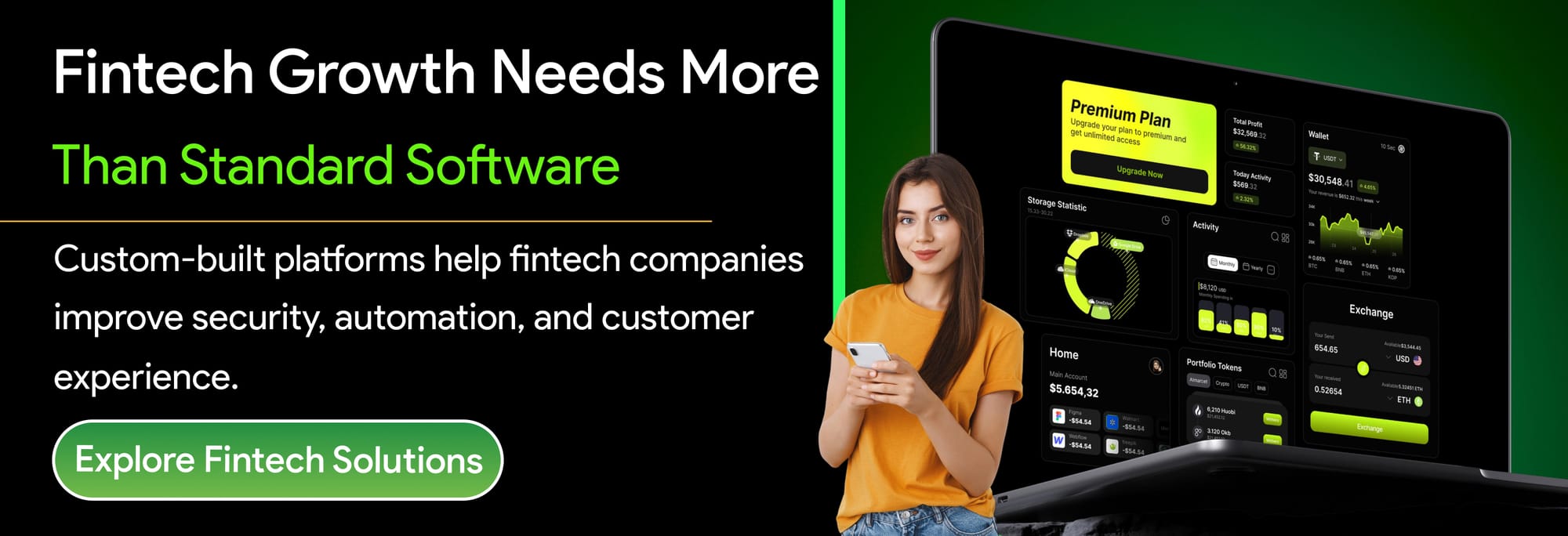
Not every agency has regulated financial products. That experience matters more than portfolio size or hourly rates. A partner worth working with will ask about your compliance environment before talking about features. They will flag technical risks early, be honest about timelines, and stay involved after launch.
The teams that do this well tend to be the ones who push back a little in early conversations. Who slows down before the build starts to make sure the architecture is right. That instinct, to get the foundation right before moving fast, is exactly what fintech products need.
The software is not a background support feature in fintech. It is the product. Regulators look at the compliance layer, the security architecture, the integrations, the user flows, it is all that users interact with on a daily basis. Those companies which develop based on generic tooling eventually reach the same limit.
Technical debt accumulates, compliance is reactive, and each new feature is more expensive than it should be. There are Custom software development services that can be used to avoid that. Not because it is always easy to build, but because in this business, the software that fits your product is what will enable you to grow long-term. That is no luxury. It is the guiding principle.
Ready-to-use software is applicable to a diverse array of industries, so it sacrifices the ability to meet compliance depth and customization of security to a broader applicability. In fintech, such trade-offs are harmful. Tailor software is created in accordance with your own regulatory requirements and user needs thus it works in those areas where the off-the-shelf software is always wanted.
The nature of compliance requirements differs according to the market and changes with time. Custom development integrates regulation logic within the product as opposed to running it via add-ons. In case of change of rules, developers are able to update only the parts without affecting everything. The kind of accuracy like that is hard to attain on a platform that you are not fully in control of.
It is dependent on the scope, but the overall cost has custom typically as an advantage over time. The cost of licensing is cumulative and retrofitting to comply or re-platforming afterwards is even more expensive than doing it at the outset.

Quick Summary * Building an AI app can cost anywhere from $15,000 to over $500
LoudOwls
Quick Summary * This blog explores the latest mobile app development trends re
LoudOwls
Key Takeaways ● A food delivery app like DoorDash typically costs $150,000
LoudOwls