AI app development cost
How Much Does It Cost to Build an AI App in 2026? A Complete Guide
Quick Summary * Building an AI app can cost anywhere from $15,000 to over $500

The selection of the right framework is one of the most important decisions in modern mobile app development. Businesses today want applications that are scalable, cost-effective, fast, and capable of running smoothly across both Android and iOS platforms without maintaining separate codebases.
This is where the debate of flutter vs react native becomes highly relevant.
Both frameworks are transforming the future of cross platform mobile app development in 2026. They allow businesses to build high-quality mobile applications using a single codebase, helping reduce development time and operational costs significantly.
According to Statista and developer surveys, over 70% of businesses now prefer cross platform app development to accelerate digital transformation while reducing maintenance costs.
But the biggest question remains:
Which framework is better for your project — Flutter or React Native?
In this detailed comparison guide, we compare Flutter and React Native based on performance, UI design, scalability, ecosystem, cost, and developer experience to help businesses make the right decision.
It would help to have a slight idea of both frameworks first before making a comparison.
Flutter is a Google-developed project that is written in Dart. It gives a full UI toolkit that has its own rendering engine that developers can use to create highly customized apps.
React Native is a JavaScript-based and React-based creation of Meta. Based on native components and bridges it communicates with platform-specific APIs.
The two frameworks are popular among startups and businesses to develop cross platform app and thus are the best options in 2026.
Before comparing the frameworks, let’s understand how both technologies work.
Flutter is a UI toolkit developed by Google for building natively compiled applications for mobile, web, and desktop platforms using a single codebase.
Flutter uses the Dart programming language and its own rendering engine to create visually rich and highly customizable applications.
Today, many startups and enterprises choose flutter app development because of its superior UI consistency and performance.
React Native is an open-source framework developed by Meta (Facebook) for building mobile applications using JavaScript and React.
Instead of using its own rendering engine, React Native relies on native components and bridges to communicate with platform-specific APIs.
Businesses often choose react native app development because of its flexibility, large ecosystem, and easy integration capabilities.
The fact that a framework is used a lot usually demonstrates its reliability and backing by the community.
According to recent data:
React Native continues to have a minor lead in job demand, though Flutter is expanding quickly, particularly when it comes to startups and new projects.
This implies that both flutter and react native developers are highly demanded and either of the two can be considered by the businesses.
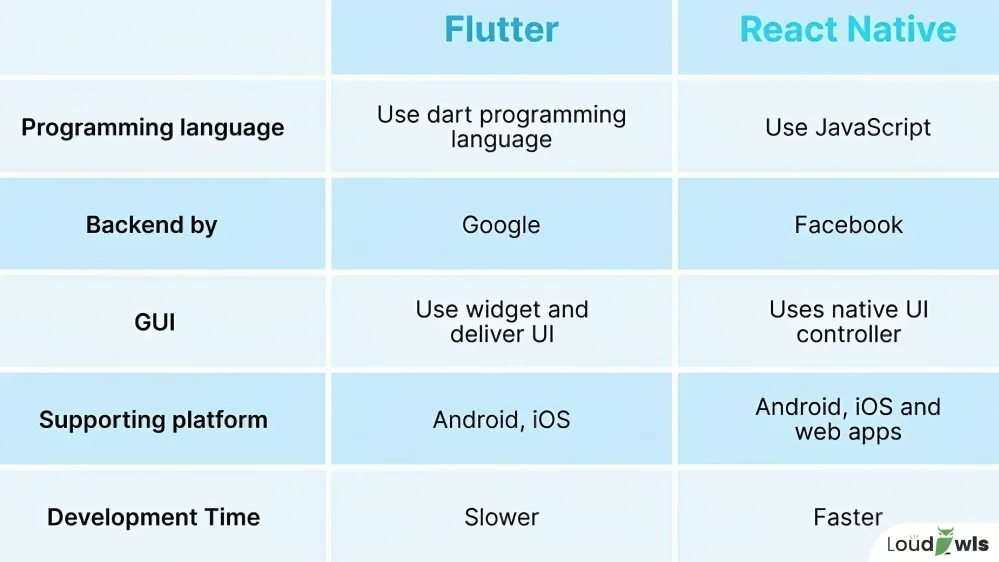
Comparison Table
One of the largest elements in the process of selecting between Flutter and React Native is performance.
Flutter has native machine code, leading it to provide smooth animations and performance consistency. Flutter is 10-25% faster in complex UI rendering in most benchmarks.
React Native, however, relies on JavaScript bridge to interact with native components. Nevertheless, its new architecture (Fabric and TurboModules) has become much higher in its performance, overcoming past limitations.
In real-world scenarios:
UI consistency is one of the largest strengths of Flutter. It applies its rendering engine and this means that your app will appear as it is in all the devices.
React Native relies on native elements, which provide apps with a more platform-specific appearance but may introduce platform differences between iOS and Android.
If your priority is:
The two frameworks are characterized by rapid development cycles.
Flutter has a hot reload capability that enables the software developer to observe the changes immediately. React Native has a similar functionality known as fast refresh.
Nevertheless, React Native possesses a benefit in the form of JavaScript ecosystem. Web development skills can be reused and hence the developers can hire app developers and accelerate the development.
On the matter of cost, the two frameworks assist in minimizing the costs over native development.
Both systems are able to afford development costs in terms of saving up to 50-70% in investment rather than creating individual applications.
The cost can however be varied according to the availability of developers:
To the majority of the businesses, the cost difference is minimal, and the decision of the project is more to be determined by the project requirements.
React Native is older and has more developers. It has a huge amount of third-party libraries and tools, which makes the development process more flexible and quicker.
The ecosystem of Flutter is expanding at a fast pace and contains more than 50,000 packages, so it has most of the development requirements covered.
React Native might be a competitive advantage to your project should it require a great deal of integration with third-party solutions. Flutter is however catching up.
Flutter will be the right choice when you:
It is particularly common with startups that are creating MVPs that have a visual emphasis.
React Native is ideal if you:
Most companies prefer it because it is flexible and is scalable.
Practical differences can be noted based on insights by developer communities:
This is a trade-off of the real world:
Cross-platform app development is no longer a trade-off in 2026; it is the norm.
Flutter and React Native have both grown in maturity:
It is no longer a question of which one is better or worse, but rather which one fits your particular scenario.
The controversy of Flutter versus react native does not have a victor.
The two frameworks are robust, scalable, and common. The correct decision is one that is contingent upon your business objectives, staff experience, and application needs.
Go with Flutter when you are interested in performance and design control. React Native is preferable in case you attach importance to flexibility, quicker hiring, and a more extensive ecosystem.
Finally, the quality of your mobile app developers is more important than the framework you use in making your app successful.
FAQs
The answer depends on your business requirements. Flutter is ideal for high-performance and custom UI applications, while React Native is excellent for faster development and third-party integrations.
Yes, Flutter generally delivers better performance because it compiles directly into native machine code, making it highly efficient for complex animations and custom interfaces.
Both frameworks help reduce mobile app development cost by allowing developers to use a single codebase for Android and iOS applications.
It is generally easier to Hire React Native Developers due to the popularity of JavaScript. However, demand for flutter developers is rapidly increasing.
Flutter is often preferred for startup MVPs because of its UI flexibility, while React Native is suitable for rapid business app deployment.
Cross platform app development helps businesses reduce development costs, accelerate deployment, and simplify maintenance.
Flutter is considered better for UI-heavy and animation-rich applications due to its custom rendering engine.
LoudOwls offers expert Mobile App Development Services including Flutter, React Native, and custom cross-platform solutions tailored for startups and enterprises.

Quick Summary * Building an AI app can cost anywhere from $15,000 to over $500
LoudOwls

Quick Summary * This blog explores the latest mobile app development trends re
LoudOwls

Key Takeaways ● A food delivery app like DoorDash typically costs $150,000
LoudOwls